
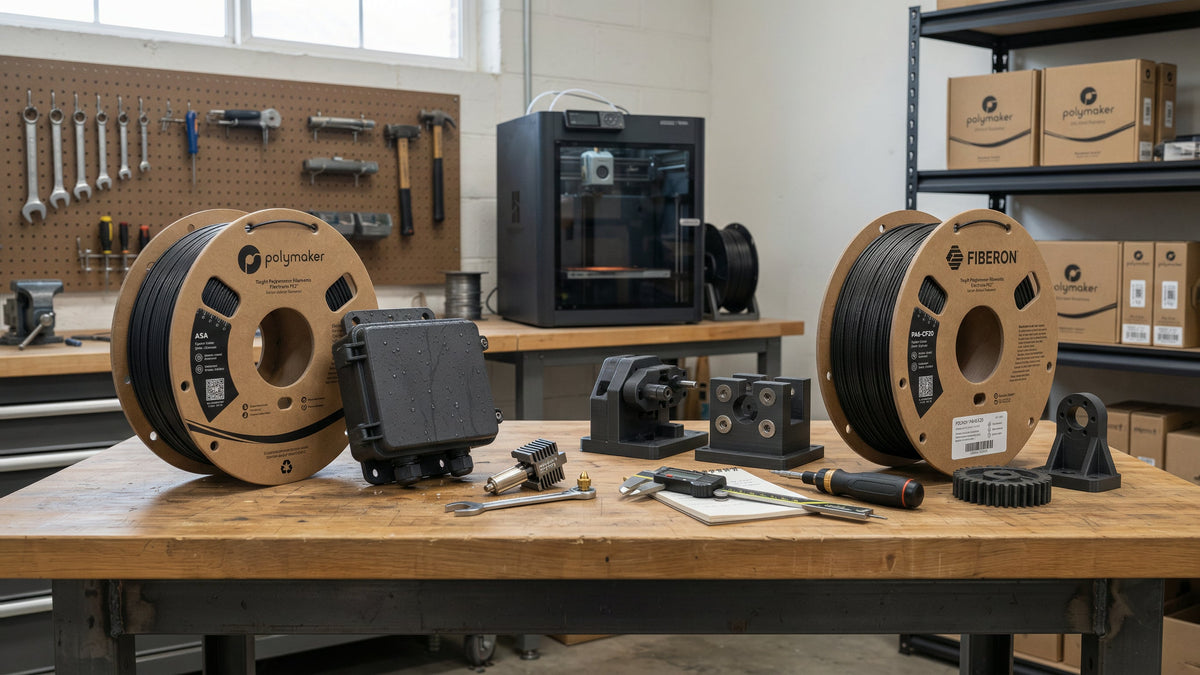
The best filament for 3D printing depends on the project: choose PLA for detailed models and prototypes, PETG for durable everyday parts, TPU for flexible components, ASA for outdoor use, and nylon, PC, or fiber-reinforced filament for demanding mechanical applications. Before buying, confirm that your printer meets the material’s temperature, enclosure, nozzle, and drying requirements.
Best Filaments for 3D Printing by Project Type
The following recommendations are starting points, not universal rankings. Compare the exact product specifications before committing to a long or load-bearing print.
PLA for Prototypes, Display Models, and Decorative Prints
Standard PLA is usually the best starting point when easy setup, clean detail, and low warping matter most. It works well for appearance prototypes, figurines, architectural models, signs, and indoor accessories, and most formulations print without an enclosure.
Choose standard PLA for parts that will remain indoors and face little heat or impact. If a prototype will be handled, assembled, or tested repeatedly, Polymaker™ PLA Pro offers improved impact resistance and layer bonding while retaining familiar PLA printing behavior. It supports print speeds up to 300 mm/s under suitable conditions, although hotend flow, cooling, layer height, and model geometry still determine the speed a specific print can sustain.
Move beyond PLA when the finished part will face prolonged outdoor exposure, elevated temperatures under load, repeated flexing, or heavy wear. Toughened PLA improves durability, but it does not turn PLA into an outdoor, flexible, or high-temperature engineering material.

PETG for Durable Everyday Parts
Choose PETG when a functional part needs more ductility, impact tolerance, or moisture resistance than standard PLA can typically provide. Brackets, equipment covers, organizers, tool accessories, and frequently handled workshop parts are common applications.
PETG is usually less brittle than standard PLA, but it is not better in every category. PLA is generally stiffer and often produces sharper small details, while PETG tends to tolerate impacts and moderate heat more effectively. For long-term UV exposure, ASA is usually the better starting point. Nylon makes more sense for repeated wear, and TPU is needed when the part must bend or compress.
For faster functional printing, Polymaker™ PETG supports print speeds up to 300 mm/s under suitable conditions and does not require an enclosure. Actual speed still depends on hotend flow, cooling, layer height, and model geometry.
Although finished PETG parts can tolerate water exposure, an unprinted spool can absorb atmospheric moisture. Keep it sealed between jobs and dry it when stringing, popping, bubbles, or rough extrusion appear.
TPU for Flexible and Impact-Absorbing Parts
TPU filament bends, stretches, and compresses without behaving like a rigid plastic. Common applications include protective covers, seals, cable straps, vibration-damping feet, flexible joints, and wearable parts.
Shore hardness helps describe how firm a TPU feels, but wall thickness and infill also affect the finished part. A thick 90A print can feel much firmer than a thin part made from the same spool.
PolyFlex™ TPU90 has a Shore hardness of 90A and is intended for soft, highly flexible parts. Because the filament can buckle inside an unsupported feed path, Polymaker recommends a direct-drive extruder. A short, constrained path and controlled print speed also help maintain steady extrusion.

ASA for Outdoor and Weather-Exposed Parts
ASA is a practical starting point when long-term sunlight and weather exposure are the main concerns. It suits outdoor housings, mounting brackets, vehicle accessories, garden equipment, and other parts that remain exposed to UV radiation and changing weather.
It is not automatically the best material for every outdoor print. PETG may be sufficient for lightly loaded parts with limited exposure, while PC or an engineering composite may be more appropriate when high temperatures or demanding mechanical loads are the main concern. Ordinary ABS offers broadly similar processing and mechanical behavior to ASA but is generally less suitable for prolonged UV exposure.
Polymaker™ ASA is intended for weather-exposed applications. It requires an enclosure that can retain warm air to reduce warping and layer separation. Print it in a well-ventilated area and follow the product-specific temperature, cooling, and bed-adhesion guidance.
Nylon, PC, and Fiber-Reinforced Filaments for Jigs, Fixtures, and Engineering Parts
These materials solve different engineering problems. Unfilled nylon filament suits gears, hinges, bushings, and other parts that need wear resistance and fatigue performance. PC is a candidate for protective structures that need impact and heat resistance. Fiber reinforcement raises stiffness and dimensional stability, making it useful for jigs and fixtures that must hold alignment.
For rigid tooling and structural prototypes, Fiberon™ PA6-CF20 uses a PA6 nylon base reinforced with 20% carbon fiber by weight. Polymaker reports an XY tensile strength of 109.3 MPa under ISO 527, but that figure applies to dry-state, annealed specimens printed at 100% infill. The value is useful for comparing controlled test specimens, but it should not be treated as a design allowable for every printed part—or as the performance of every PA-CF filament.
PA6-CF20 requires an all-metal hotend capable of at least 280°C, a 0.4 mm or larger abrasion-resistant nozzle, and strict moisture control. Polymaker specifies annealing at 100°C for 16 hours when the performance reported for annealed specimens is required.

3D Printer Filament Comparison at a Glance
|
Project or Priority |
Good Starting Point |
Main Advantage |
Printer and Handling Needs |
Main Tradeoff |
|
Detailed models and prototypes |
PLA |
Easy printing and clean detail |
Most grades need no enclosure |
Limited heat and impact resistance |
|
Everyday functional parts |
PETG |
Toughness and strong layer bonding |
Heated bed and dry storage |
Stringing and lower stiffness than PLA |
|
Flexible covers and dampers |
TPU |
Flexibility and impact absorption |
Constrained feed path; direct drive may be recommended |
Softer grades are harder to feed |
|
Outdoor housings and mounts |
ASA |
UV and weather resistance |
Heated bed, enclosure, and ventilation |
Warping and more demanding printing |
|
Gears and moving parts |
Nylon |
Wear and fatigue resistance |
Thorough drying and protected feeding |
Rapid moisture absorption |
|
Impact- and heat-exposed parts |
PC |
Impact resistance and thermal performance |
High-temperature hotend and enclosure; some grades need a heated chamber |
Warping and demanding equipment |
|
Rigid jigs and fixtures |
PA-CF and other suitable reinforced grades |
Stiffness and dimensional stability |
Abrasion-resistant nozzle; material-specific hotend and drying requirements |
Often lower elongation than the unfilled base polymer |
The table narrows the options, but it does not replace a product data sheet. Formulation, test direction, moisture condition, annealing, and print settings can produce large differences within the same material family. Use the Polymaker Filament Guide to compare materials by application, printer requirements, and handling needs.
How to Choose the Right Filament for Your 3D Printing Project
The best material is not necessarily the strongest or most expensive one. It is the filament that meets the part’s mechanical and environmental requirements without exceeding the printer’s capabilities.
Start With the Part’s Function and Likely Failure Mode
Write down what the finished part must do and how it is most likely to fail. A rigid fixture needs to resist bending, a protective housing may need to survive an impact, and a clip must flex repeatedly without cracking.
Strength is not a single measurement. Tensile strength describes the maximum tensile stress a test specimen can withstand, while stiffness reflects how strongly it resists deformation. Impact resistance, elongation, wear resistance, and fatigue behavior may matter more than tensile strength for parts that are dropped, bent, or moved repeatedly.
Print orientation also affects performance. A high XY tensile value does not guarantee the same strength between layers in the Z direction. Test load-bearing or safety-related parts in their finished geometry and use an appropriate safety factor.
Consider Heat, UV, Moisture, and Chemical Exposure
Estimate the highest service temperature and determine whether the part will carry a load at that temperature. A material that keeps its shape while resting on a shelf may still deform when heat and mechanical stress act together.
For parts that mainly need to retain their shape in warm conditions without a significant load, Polymaker™ HT-PLA offers PLA-like printing with better heat stability than standard PLA. Its high-temperature shape-retention claim should not be treated as a load-bearing service-temperature rating. For parts exposed to both heat and mechanical stress, compare HDT values under the stated test load and follow the product’s annealing guidance.
Outdoor parts also need resistance to sunlight, rain, and temperature changes. ASA is usually a better starting point than standard PLA or ordinary ABS for long-term UV exposure. Chemical resistance must be checked against the exact substance, concentration, exposure time, and temperature.
Make Sure Your Printer Can Process the Material
Check the required nozzle and bed temperatures, enclosure conditions, extruder design, filament diameter, and build surface. TPU needs a well-supported filament path, while carbon- and glass-fiber materials require an abrasion-resistant nozzle.
Some PC grades need an enclosed printer, and certain formulations or large, dense parts may require a heated chamber. Nylon and other moisture-sensitive materials may need drying before printing and protected feeding during longer jobs.
Also check spool compatibility. A filament may work with the hotend but still require an external holder or adapter because of its spool diameter, width, rim design, or material.
Balance Printability, Surface Finish, and Total Cost
PLA generally produces clean detail with limited warping. Matte and silk formulations change the appearance of a print, but their flow, layer bonding, and mechanical behavior may differ from standard PLA.
The cheapest spool does not always produce the lowest-cost part. Include failed prints, tuning time, drying equipment, nozzle wear, post-processing, and material availability when comparing value. A moderately priced filament that prints consistently may cost less per successful part than a high-performance material the printer cannot process reliably.
Practical Tips for Better 3D Prints
Material selection sets the foundation. A few setup choices determine whether the finished part delivers the expected performance.
Start With the Filament Manufacturer’s Temperature Range
Use the profile for the exact product, not a generic temperature copied from another spool with the same polymer name. Additives and fillers change flow, cooling, and bed-adhesion behavior.
Begin inside the published range and adjust in small steps. Raising the nozzle temperature may improve layer bonding, but excessive heat can increase stringing, reduce detail, or degrade the material.
Adjust Print Speed and Cooling for the Material
A manufacturer’s maximum speed is not a promise that every model can print at that rate. Actual output depends on the hotend’s volumetric flow, line width, layer height, acceleration, cooling, and geometry.
PLA often tolerates more cooling. ABS, ASA, PC, and many reinforced engineering materials generally need limited or no part cooling to preserve layer bonding and control warping. Follow the exact product profile.
Keep Filament Dry Between Prints
The right 3D printer filament storage method may involve a sealed bag, a container with desiccant, or a direct-feed dry box, depending on the material and how often it is used.
Storage preserves a dry spool; it does not reliably remove moisture already inside the filament. If moisture symptoms appear, a 3D printer filament dryer can remove absorbed water through controlled heat and airflow. Follow the drying profile for the exact material before changing retraction or flow settings.
Match the Nozzle Material and Size to the Filament
A standard brass nozzle works for many unfilled PLA and PETG products. Carbon fiber, glass fiber, glow additives, and other abrasive fillers require hardened steel, tungsten carbide, ruby-tipped, or another wear-resistant nozzle.
Filled materials may also need a larger opening to reduce clogging. Check the manufacturer’s minimum nozzle diameter instead of assuming every filament will run through a standard 0.4 mm brass nozzle.
Conclusion
The best 3D printing filament is the one that matches the part’s function, operating environment, and printer requirements. Use PLA for accessible prototypes, PETG for everyday functional parts, TPU for flexibility, ASA for outdoor exposure, and engineering materials only when their specific performance advantages justify the additional hardware and material care.
FAQ
What Is the Best All-Around Filament for 3D Printing?
PLA is the easiest all-around option for models, prototypes, and indoor accessories. PETG is often a better general-purpose choice for functional parts that need more ductility, impact tolerance, and heat resistance. Neither is best for every application.
Which 3D Printer Filament Is Best for Outdoor Use?
ASA is usually one of the most practical starting points for long-term outdoor parts because it is designed for UV and weather resistance. PETG can work in some outdoor applications, but performance varies by formulation, load, temperature, and length of exposure.
What Is the Easiest 3D Printer Filament for Beginners?
Standard PLA is generally the easiest. It prints at moderate temperatures, has low shrinkage, and usually does not require an enclosure. Begin with the manufacturer’s profile rather than relying on one universal PLA setting.
Which Filament Is Best for Strong and Durable 3D Prints?
It depends on how the part may fail. PA-CF suits parts that need stiffness and dimensional stability. PC is a candidate for impact and heat, while unfilled nylon works well for wear and repeated movement. Print orientation and layer bonding can matter as much as the material name.
Can Different Filaments Be Used on the Same 3D Printer?
Yes, as long as the printer meets each filament’s hotend, bed, enclosure, nozzle, and feeding requirements. Changing from PLA to PETG may require only a new profile, while TPU, PC, or PA-CF may require different hardware and handling.