


5-10 days
Payments
Beschreibung
Beschreibung
Fiberon™ PETG-ESD: ESD-sicheres PETG für Elektronikanwendungen (früher PolyMax™ PETG-ESD)
Schutz vor elektrostatischer Entladung (ESD)
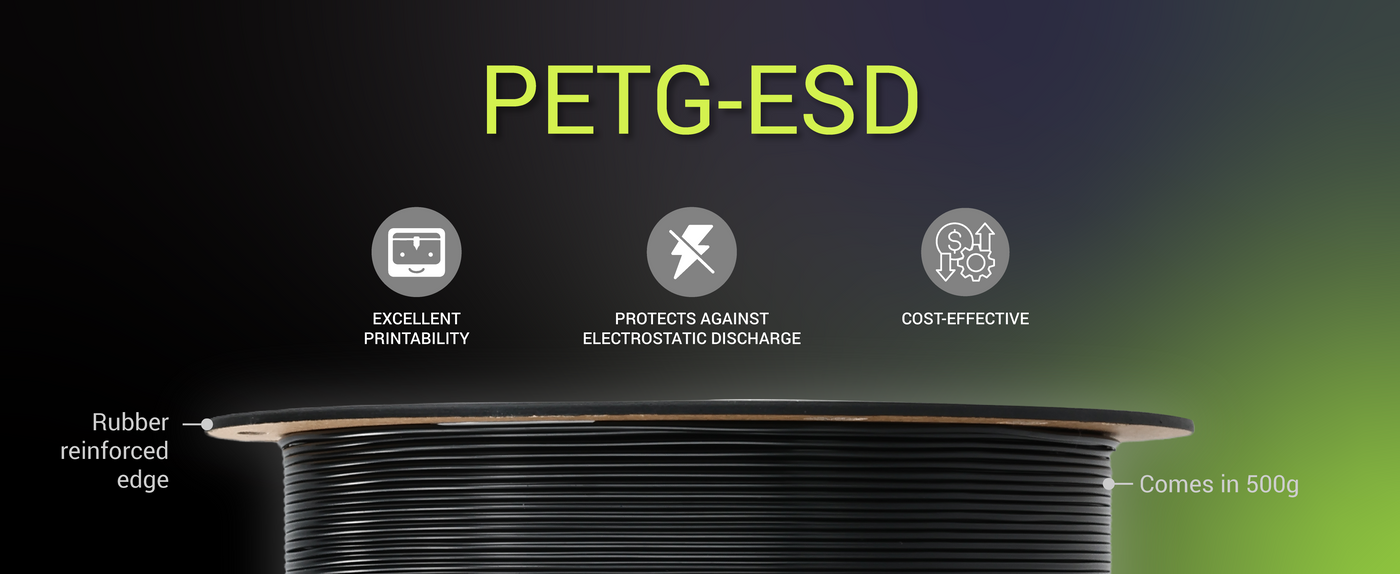
Fiberon™ PETG-ESD wurde gezielt für zuverlässigen Schutz vor elektrostatischer Entladung (ESD) entwickelt und ist damit eine ausgezeichnete Wahl für gedruckte Teile in Fertigung, Montage und Handhabung von Elektronik. Diese Eigenschaft schützt empfindliche elektronische Bauteile während der Produktion und im Einsatz vor Schäden durch statische Elektrizität.
Erhöhte Zähigkeit
Über den ESD-Schutz hinaus bietet Fiberon™ PETG-ESD eine höhere Zähigkeit als Standard-PETG und damit mehr Schlagzähigkeit und Langlebigkeit für anspruchsvolle industrielle Anwendungen.
Hochentwickelte Compoundierung mit Kohlenstoff-Nanoröhrchen
Dieses Filament ist mit Kohlenstoff-Nanoröhrchen compoundiert, die für seine ESD-sicheren Eigenschaften verantwortlich sind. Sie sorgen für eine gleichmäßige Leitfähigkeit im gesamten gedruckten Bauteil, sodass der ESD-Schutz auch nach spanender Bearbeitung oder Verschleiß erhalten bleibt.
Ideale Anwendungen
- Gehäuse und Verkleidungen für Elektronik
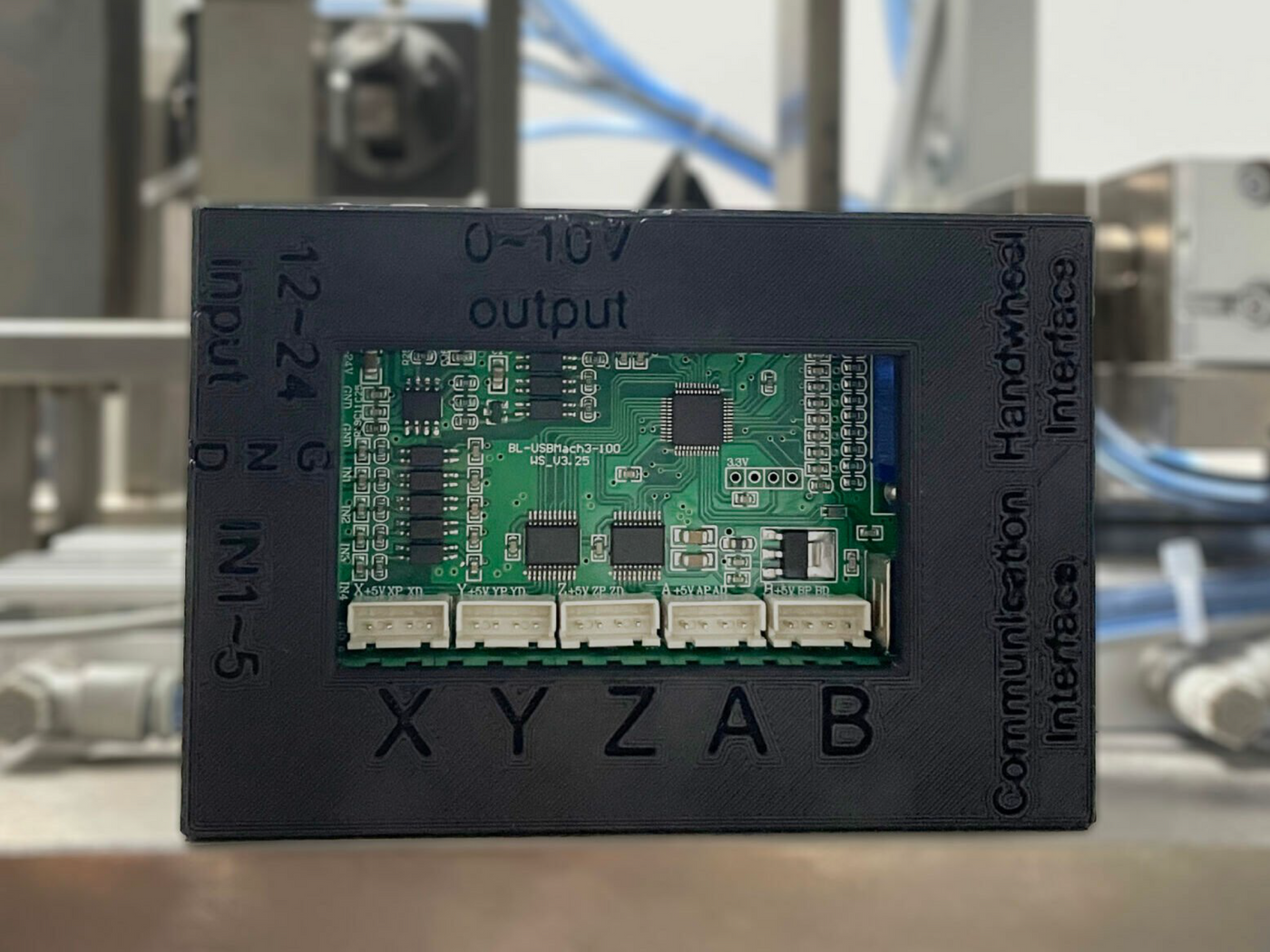
- Vorrichtungen und Halterungen für die Leiterplattenmontage
- Trays und Aufbewahrung für elektronische Bauteile
- Werkzeuge und Bauteile für ESD-empfindliche Umgebungen
Setz auf Fiberon™ PETG-ESD für deine Elektronikprojekte, wenn du ein zähes, zuverlässiges und ESD-sicheres Druckmaterial brauchst.
Hinweis: ™ PETG-ESD ist mit Kohlenstoff-Nanoröhrchen compoundiert:
Hier findest du eine Studie zu ABS, das mit Kohlenstoff-Nanoröhrchen compoundiert wurde.
Druckanforderungen
Druckeinstellungen
Druckeinstellungen
Fiberon™ PETG-ESD
- ESD Protection
- Enhanced Toughness
- Carbon Nanotube Technology
- Ideal for Electronics
- Ready to Print ;
Fiberon™ PETG-ESD - Black / 0,5 kg ist nachbestellt und wird versendet, sobald es wieder auf Lager ist.

Technische Daten
Alles, was du vor dem Druck wissen musst
- Use a hotend suitable for the 250-290°C nozzle-temperature range; an all-metal hotend is recommended.
- Dry at 65°C for 3 hours if the filament has absorbed moisture, and keep it dry during use.
- Keep the cooling fan OFF ; use a 70-80°C build plate.
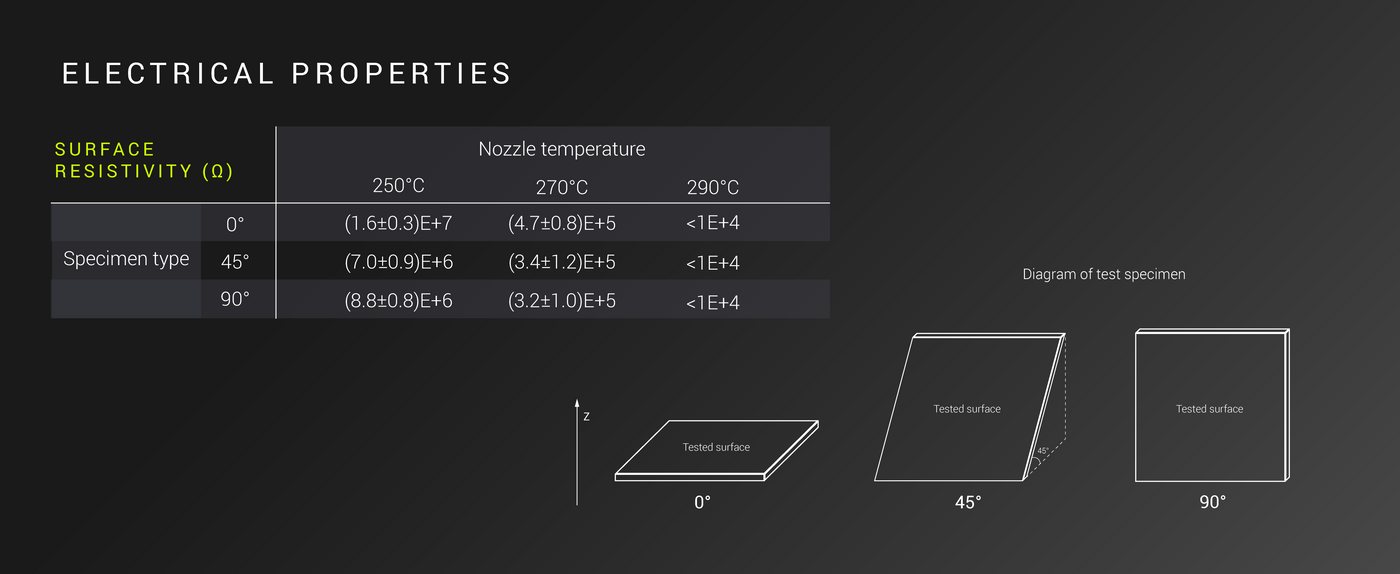
- Nozzle temperature and print orientation strongly affect surface resistivity. Higher nozzle temperatures lower resistivity; validate the finished part for the intended ESD requirement.
- Annealing is not specified for this material.
| Property | X-Y | Z | Value | Method |
|---|---|---|---|---|
| Density | — | — | 1.24 g/cm³ Important | ISO 1183 |
| Tensile strength | 36.1 MPa Important | 20.7 MPa Important | — | ISO 527 |
| Elongation at break | 7.3 % Important | 1.8 % Important | — | ISO 527 |
| Bending strength | 54 MPa Important | 24.1 MPa Important | — | ISO 178 |
| Bending modulus | 1650.8 MPa Important | — | — | ISO 178 |
| Young's modulus | 1983 MPa Important | 1626.4 MPa Important | — | ISO 527 |
| Charpy, unnotched | — | 5.2 KJ/m² Important | — | ISO 179 |
| Charpy, notched | 5.7 KJ/m² Important | — | — | ISO 179 |
| Glass transition temperature (Tg) | — | — | 77 °C Important | ISO 11357 |
| Vicat softening temperature | — | — | 86 °C Important | ISO 306 |
| HDT (0.45 MPa) | — | — | 76 °C Important | ISO 75 |
| HDT (1.8 MPa) | — | — | 72 °C Important | ISO 75 |
Getestet an Prüfkörpern mit 100 % Infill. X-Y = quer zu den Schichten, Z = zwischen den Schichten (Schichthaftung).
Häufige Fragen
Du hast Fragen? Wir haben die Antworten. Von der Materialwahl bis zur Pflege deiner Spulen - hier findest du alles Wichtige an einem Ort.
How long will PETG-ESD remain ESD safe?
Do you have any further data?
Will the spools work in an AMS?
What is the difference between PET and PETG?
Customers praised this ESD-safe filament for printing jigs and tools in electronics manufacturing, noting it "prints well and consistently" while being "more affordable than pretty much any other name brand." Quality and speed performance were highlighted, though some reported occasional plate adhesion issues and residue.
I use this filament to print ESD-safe jigs and tools for the electronics manufacturing company I work for. It prints well and consistently while being more affordable than pretty much any other name brand ESD filament on the market. Now I'm just waiting for Polymaker to do a PLA-ESD.
The filament prints great, but it does have an issue with sticking to the plate sometimes and leaving residue on the plate.
PETG-ESD filament is great! Very useful for printing ESD safe jigs for assembly. Print quality is good on Bambu printers.
Many people confuse ESD with conductive filament. This has a resistance around 1-100M ohms (10^6-10^8). You cannot test this with a basic multimeter, and even then the resistance changes as your voltage changes. With a proper ESD tester, you can measure its resistance.
Really like it, prints really well and can take speed.
This is by far the best PETG ESD I have used and is very competitively priced!I would really like to see 1kg spool though, 0.5kg spools are really annoying to work with since I'm constantly having to swap to a new spool mid print. And, with the switch to the Fiberon branding, they started taping the end of the filament to the spool core. This is a big PROBLEM as it can get stuck during when the filament runs out cause the filament runout sensor not to trigger. PLEASE revert back to not using tape.Also, I'd really like to see Polymaker submit well tuned filament profiles for all the Prusa machines to Prusa Slicer.
Printed great in my x1c. I through it straight from the package into my dryer for like 12 hours then printed from the dryer. No issues
