
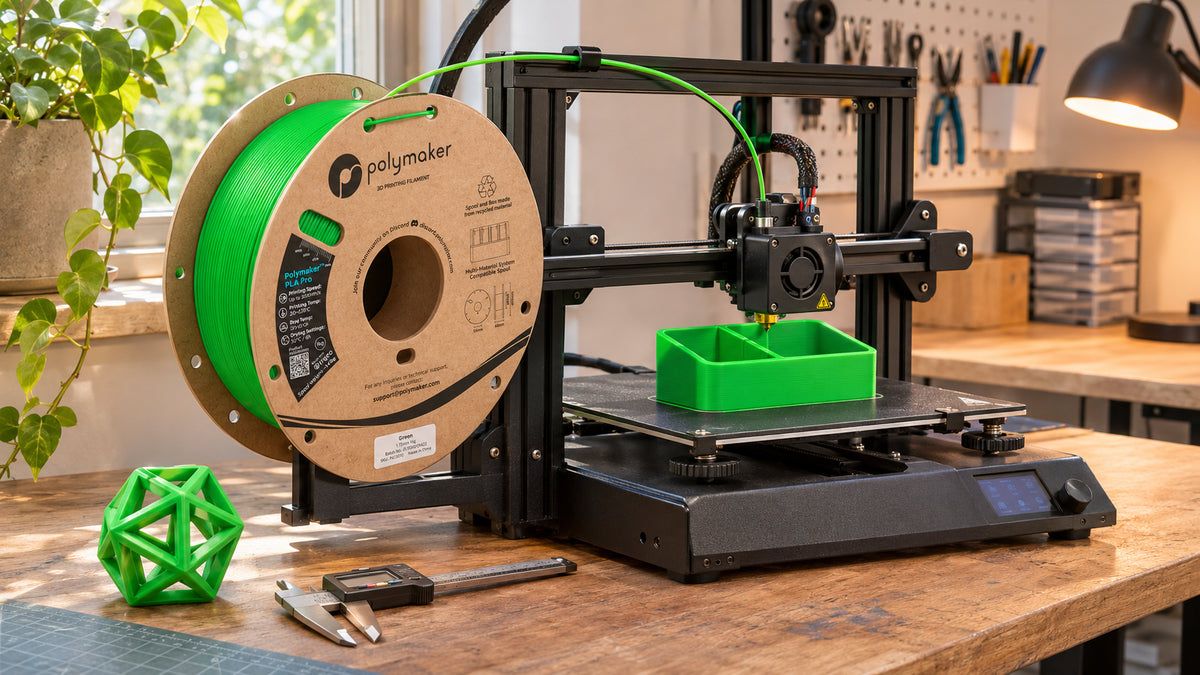
PLA is often the first spool loaded into a new FDM printer. It prints at moderate nozzle temperatures, usually works without an enclosure, and comes in a wide range of colors. That combination makes it easier for beginners to get through their first projects without spending hours troubleshooting the material.
Still, PLA filament is not a single, standardized formula. Matte blends can soften the appearance of layer lines, silk PLA needs the right settings to maintain an even shine, and fiber-filled products may require a wear-resistant nozzle. Strength, toughness, and heat resistance can also vary from one spool to another. This guide examines PLA filament 3D printing from a practical angle, helping you choose the right formulation and get more consistent results.

What Is PLA Filament?
PLA is short for polylactic acid, a thermoplastic often made from plant-based raw materials. In an FDM printer, the process is simple: filament feeds into the hotend, melts, and comes out through the nozzle in thin lines. Layer by layer, those lines form the finished part.
Most 3D printer PLA filament is sold in a 1.75 mm diameter and runs well on open-frame desktop machines. It doesn’t shrink much as it cools, so corners are less likely to lift from the build plate. The tradeoff shows up in demanding situations. Standard PLA is stiff but may crack when dropped, and a part left inside a hot car can soften or lose its shape.
What Are the Key Properties of PLA Filament?
PLA has a reputation for being easy to print, and in most cases, it earns it. Parts come off the bed with sharp edges and stable dimensions. The bigger question is what happens afterward. Will the print sit on a shelf, hold weight, or spend time somewhere warm? The answer matters more than the word “PLA” on the spool.
Mechanical Properties of PLA Filament
Pick up a PLA box or bracket and it will usually feel solid. The material is stiff, so walls do not bend much under a light load. That can be useful—until the part takes a hit. A thin tab that might flex in another plastic may simply crack.
Design and print direction make a noticeable difference. Adding another wall often helps more than raising the infill, and a part loaded across its layer lines may fail sooner than the same model printed in another orientation. No filament can make up for a weak design.
Heat Resistance of PLA Filament
A PLA part may work perfectly on a desk and fail after one afternoon in a parked car. Many standard formulas start to lose stiffness around 55–65°C, though the exact limit changes with the product, shape, and load.
PolyLite PLA lists a glass-transition temperature of 61°C, along with heat-deflection values of 58–60°C. Those figures make ordinary PLA a questionable choice for dashboard accessories, appliance parts, or anything mounted beside a heater.

Printability and Dimensional Accuracy
This is where PLA has an advantage. It does not shrink much while cooling, so corners tend to stay down and larger prints are less prone to warping. An open-frame desktop printer can usually handle it without much fuss.
Still, accurate filament cannot rescue a poorly calibrated machine. Excess flow makes holes too small. A loose belt shifts walls, and a bad Z offset can spread the bottom of a model beyond its intended size. Check the printer before changing materials.
Surface Quality of PLA Prints
Fine lettering and small decorative features often look clean in PLA. Standard formulas can appear smooth or slightly glossy. Matte PLA reduces reflections and hides some layer lines, while silk blends produce a bright finish that can resemble metal.
The profile affects the result just as much as the formula. Run the nozzle too hot and small details may soften. Too cool, and the surface can turn rough as layer bonding begins to suffer.
Environmental Impact of PLA Filament
PLA often comes from plant-based feedstocks, but that does not make a printed part home-compostable. A failed print left in a garden will not simply disappear. Breaking PLA down usually requires an industrial facility with controlled heat, moisture, and airflow, and many areas do not offer that service.
The practical approach is less glamorous: prevent failed prints, test large models at a smaller scale first, and keep clean scraps for any recycling or reuse program available locally.
Exploring the Different Types of PLA Filament
The best PLA filament is the one that matches the job. A display model and a load-bearing bracket need different properties, even if both can technically be printed in PLA.
Standard PLA Filament
Standard PLA covers most everyday projects: prototypes, organizers, toys, models, signs, and light-duty accessories. It tends to be affordable, widely compatible, and easy to tune.
When comparing PLA 3D printer filament, check the diameter, recommended settings, available colors, and spool dimensions. Consistent extrusion often matters more than a dramatic strength claim.
You may also run across listings labeled 20 colors PLA filament refills for 3D pen printer. These usually contain short strands made for 3D pens, not full printer spools. Check the diameter and total quantity before ordering.
PLA+ (PLA Plus or PLA Pro)
PLA+, PLA Plus, and PLA Pro usually describe modified formulations designed to improve toughness or impact resistance. The names are not governed by one standard, so performance varies from one brand to another.
If standard PLA feels too brittle for brackets, housings, or shop fixtures, Polymaker PLA Pro offers a tougher option without giving up familiar PLA printing behavior. Its formulation focuses on impact resistance, layer adhesion, and dimensional stability, which makes the recommendation fit functional parts rather than purely decorative models.
Matte PLA Filament
Matte PLA cuts down glare and makes layer lines less obvious, giving architectural models, props, and display pieces a softer, more uniform finish. That softer finish suits architectural models, props, sculptures, and products meant for display.
Don’t assume the material will print exactly like standard PLA. The additives that create the finish can also change flow, strength, and layer bonding. Start with the profile for that specific spool.

Silk PLA Filament
Silk PLA produces a reflective surface that can look metallic without painting. Vases, ornaments, trophies, and articulated models are common uses.
Getting an even shine takes some tuning. Temperature and speed affect how light reflects from the extrusion lines, while poorly adjusted retraction may leave strings between detailed features. Silk PLA is usually chosen for appearance, not demanding mechanical work.
Composite and Filled PLA Filament
Filled PLA uses materials such as wood particles, mineral powders, or chopped fibers to change its appearance or behavior. Wood and marble effects are mainly decorative. Carbon fiber shifts the focus toward rigidity, dimensional stability, and a more uniform matte surface.
PolyLite PLA-CF contains 8% chopped carbon fiber by weight, making it a useful option for rigid prototypes where clean dimensions matter. The fibers are abrasive, so Polymaker recommends a hardened nozzle instead of an ordinary brass one.
Common Applications of PLA Filament in 3D Printing
PLA fits projects that need detail and stable dimensions but won’t face high heat, harsh weather, or repeated impacts.
Prototyping and Product Design
Designers often use PLA for fit checks, enclosure concepts, and early design revisions. It prints quickly and holds dimensions well enough to reveal obvious design problems before moving to a more specialized material.
For mechanical testing, make sure PLA’s heat and impact limits won’t distort the results.
Educational Models and Teaching Aids
Maps, geometric shapes, anatomical models, and classroom demonstrations are natural PLA projects. Students can focus on design and slicing without first learning how to manage severe warping or a heated enclosure.
Decorative Models and Miniatures
PLA handles small details well, which helps with figurines, ornaments, cosplay props, and display pieces. Matte material hides some layer lines, while silk, gradient, and multicolor options add visual effects straight from the printer.
Household Items and Everyday Accessories
Cable clips, drawer dividers, labels, desk stands, and storage organizers rarely demand extreme material performance. PLA often works well for them. Keep it away from hot water, heaters, strong sunlight, and loads that could cause a brittle part to crack.
Practical Tips for Better PLA 3D Printing Results
Even a recommended PLA filament can print poorly with the wrong profile. Use the manufacturer’s settings as a starting point, then adjust one variable at a time.
Properly Drying and Storing PLA Filament

PLA absorbs moisture more slowly than nylon or PVA, but an exposed spool can still develop stringing, bubbles, brittle sections, or a rough finish. A sealed bag and fresh desiccant slow down moisture absorption; they do not remove water already inside the material.
If you manage several open spools, PolyDryer™ connects active drying with sealed storage. Its Dry Dock circulates warm air around the spool, while the removable box can stay closed for storage or feed filament directly to the printer. Use the drying profile for the exact PLA product, since additives can change the required conditions.
Setting the Right Printing Temperature
PLA does not have one universal nozzle temperature. Standard products often print somewhere around 190–230°C, while silk, toughened, filled, and high-speed formulas may need different settings.
Start near the middle of the manufacturer’s range. Weak layer bonding may call for a small temperature increase. Soft details, heavy stringing, or excessive oozing can indicate that the nozzle is too hot.
Optimizing Print Speed and Cooling
Cooling helps PLA hold overhangs, bridges, and small details. During the first layer, however, too much fan can weaken adhesion. Many profiles reduce or disable cooling at the start and bring it up over the next few layers.
Speed must also match the hotend’s flow capacity. If the printer moves faster than it can melt the material, gaps and weak extrusion will show up even with a high-speed filament.
Improving First-Layer Bed Adhesion
Clean the build plate and check the nozzle height before changing slicer settings. The first layer should look slightly compressed, with adjacent lines touching but not spreading into a rough ridge.
Slow the first layer if adhesion remains inconsistent. A brim can help narrow or tall parts, but it won’t fix an oily surface or an incorrect Z offset.
Troubleshooting Common PLA Printing Problems
Stringing may come from moisture, high nozzle temperature, or unsuitable retraction. Weak layers can point to low temperature, excessive cooling, or under-extrusion. A clicking extruder often signals a clog, restricted filament path, or flow rate the hotend cannot maintain.
Work through one possible cause at a time. Drying won’t repair a worn nozzle, and raising the temperature won’t solve wet filament.
Conclusion
PLA offers an approachable mix of detail, dimensional stability, color choice, and easy printing. Match the formulation to the job instead of treating every PLA spool as interchangeable. Once the material is selected, a sensible temperature, controlled cooling, a clean first layer, and dry storage will do more for print quality than constant slicer adjustments.
FAQ
What Temperature Does PLA Soften At?
Standard PLA often starts losing stiffness around 55–65°C, but the exact value depends on the formulation, applied load, and part geometry. Check the product’s glass-transition or heat-deflection data when the print will be exposed to warmth.
Does PLA Filament Expire or Go Bad?
PLA has no simple expiration date. Moisture, ultraviolet light, and heat can degrade an open spool over time. Drying may restore moisture-affected filament, but it cannot reverse permanent chemical or UV damage.
Can PLA Be Used Outdoors?
PLA can handle temporary outdoor use, especially when the part carries little load. Long-term sunlight, rain, and high summer temperatures may cause fading, brittleness, or deformation. ASA is generally a better option for permanent exterior parts.
Can PLA Filament Be Painted or Glued?
Yes. Sanding and primer help paint stick and hide layer lines. Cyanoacrylate glue and two-part epoxy can join PLA parts, although the best choice depends on the joint design and required strength. Test the finish on scrap material first.
How Long Do PLA 3D Prints Last?
Indoor PLA prints can remain usable for years when protected from heat, sunlight, moisture, and heavy mechanical stress. Lifespan depends on the formulation, print quality, wall thickness, load, and surrounding environment—not just the word PLA on the spool.