


5-10 days
Payments
Beschreibung
Beschreibung
PolyMax™ PETG: Zähigkeit und Vielseitigkeit auf neuem Niveau
PolyMax™ PETG ist für anspruchsvolle Anwendungen entwickelt und übertrifft herkömmliche PETG-Filamente mit außergewöhnlicher mechanischer Festigkeit und Belastbarkeit.
Höhere Zähigkeit und Schlagfestigkeit
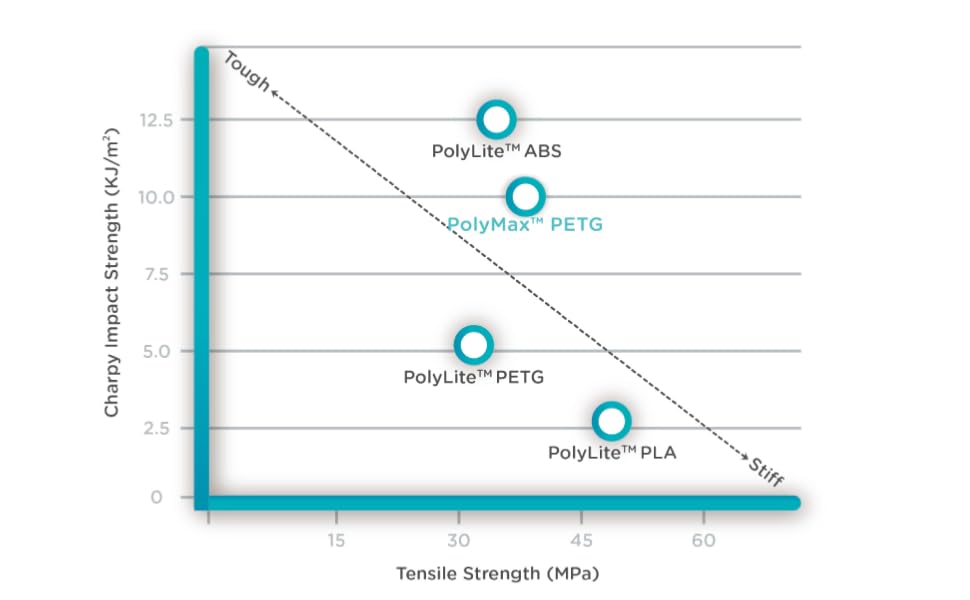
Aufbauend auf der bekannten Chemikalienbeständigkeit von PETG bietet PolyMax™ PETG eine deutlich höhere Bruchzähigkeit als PolyLite™ PETG. Die fortschrittliche Rezeptur sorgt für bessere Duktilität und herausragende Schlagzähigkeit, für Teile, die im Alltag echter Belastung standhalten müssen.
Innovativer modifizierter PETG-Blend
PolyMax™ PETG vereint das Beste aus PETG und PCTG: hohe Festigkeit und Steifigkeit bei gleichzeitig verbesserter Flexibilität und Belastbarkeit. Diese besondere Balance macht es ideal für Funktionsprototypen ebenso wie für Endanwendungen, die Langlebigkeit und Zuverlässigkeit verlangen.
Setz auf PolyMax™ PETG, wenn dein Projekt maximale Zähigkeit erfordert, ohne Kompromisse bei Druckbarkeit oder Leistung.
Druckanforderungen
Druckeinstellungen
Druckeinstellungen
PolyMax™ PETG
- High Toughness
- Impact Resistant
- PETG/PCTG Blend
- Chemical Resistant
- Ideal for Functional Parts
PolyMax™ PETG - Black / 1,75 mm / 0,75 kg ist nachbestellt und wird versendet, sobald es wieder auf Lager ist.

Technische Daten
Alles, was du vor dem Druck wissen musst
- Keep the filament sealed and dry; use the listed 65°C / 6h drying cycle if moisture-related defects appear.
- Dry the filament first, then tune retraction and travel settings if stringing remains.
- Use a suitable adhesive as a release layer and let the build plate cool before removing the part.
- Reduce cooling and dry the filament if stringing or weak layer adhesion appears.
- Start within the recommended 230 - 260°C nozzle and 70 - 80°C bed ranges, then make small adjustments for the printer and model.
- Use the recommended OFF - 20% cooling-fan setting and keep printing speed within 50 - 100 mm/s.
| Property | X-Y | Z | Value | Method |
|---|---|---|---|---|
| Density | — | — | 1.24 g/cm³ Important | ISO 1183 |
| Tensile strength | 37.9 MPa Important | 29.4 MPa Important | — | ISO 527 |
| Elongation at break | 5.22 % Important | 3.1 % Important | — | ISO 527 |
| Bending strength | 58.3 MPa Important | 55.1 MPa Important | — | ISO 178 |
| Bending modulus | 1068 MPa Important | — | — | ISO 178 |
| Young's modulus | 1684 MPa Important | 1603 MPa Important | — | ISO 527 |
| Charpy, notched | 11.6 KJ/m² Important | — | — | ISO 179 |
| Glass transition temperature (Tg) | — | — | 76.83 °C Important | ISO 11357 |
| Vicat softening temperature | — | — | 82 °C Important | ISO 306 |
| HDT (0.45 MPa) | — | — | 76 °C Important | ISO 75 |
| HDT (1.8 MPa) | — | — | 72 °C Important | ISO 75 |
Getestet an Prüfkörpern mit 100 % Infill. X-Y = quer zu den Schichten, Z = zwischen den Schichten (Schichthaftung).
Häufige Fragen
Du hast Fragen? Wir haben die Antworten. Von der Materialwahl bis zur Pflege deiner Spulen - hier findest du alles Wichtige an einem Ort.
