
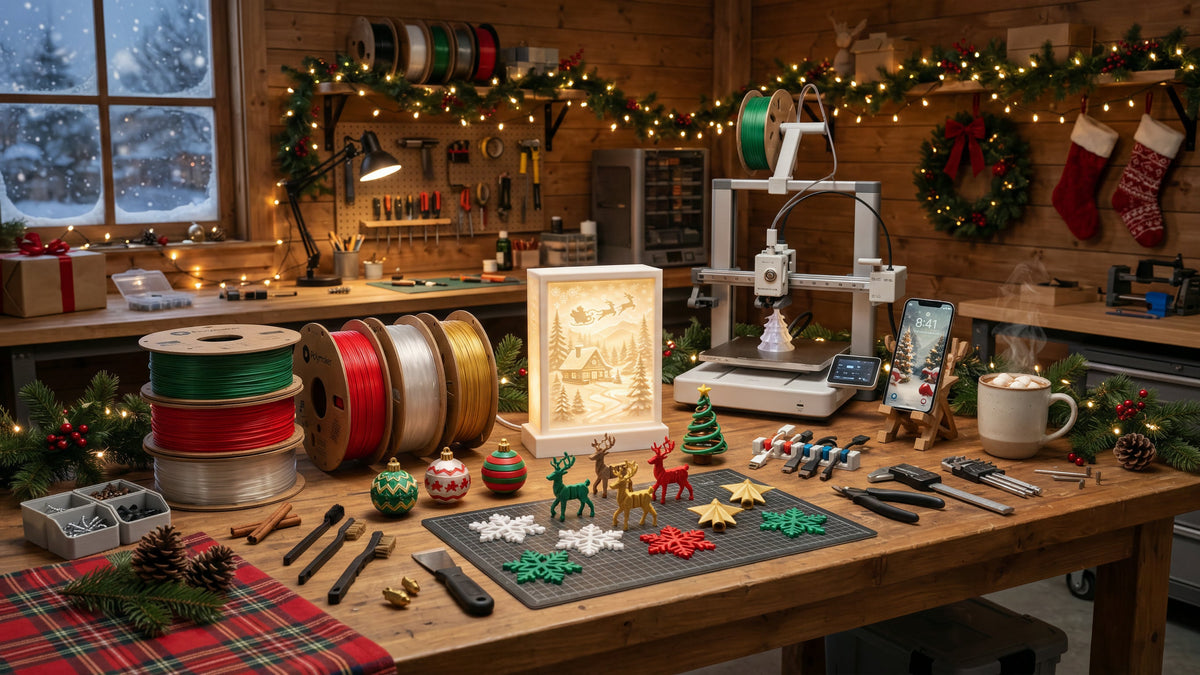
The best 3D printed gifts feel personal without becoming impractical. Start with the recipient, then match the design, material, and amount of work to the way the gift will be used. Leave enough time to test fitted parts, recover from a failed print, complete the assembly, and package everything before Christmas.
Good 3D printed gift ideas range from quick stocking stuffers to multipart projects that require lighting, hardware, or careful finishing. The table below provides a practical starting point. Print-time categories are relative because the final estimate depends on model size, layer height, infill, supports, and printer speed.
|
Gift Idea |
Best For |
Relative Print Time |
Suggested Material |
What to Check |
|
Personalized name ornament |
Family, teachers, and coworkers |
Short |
Standard, matte, or silk PLA |
Letter thickness and hanging-loop strength |
|
Lithophane light box |
Parents, partners, and close friends |
Medium to long |
White PLA |
Image preparation, wall thickness, LED module, and assembly |
|
Phone stand or desk organizer |
Students and coworkers |
Short to medium |
PLA or PETG |
Phone-case thickness, viewing angle, and base stability |
|
Controller or tool holder |
Gamers, makers, and DIYers |
Medium |
PLA or PETG |
Device dimensions, mounting holes, screws, and load direction |
|
Flexible cable holder or strap |
Travelers and desk users |
Short to medium |
TPU |
Shore hardness and printer feeding compatibility |
|
Sliding gift card holder |
Coworkers and stocking stuffers |
Short |
PLA |
Card dimensions, clearance, and sliding mechanism |
Best 3D Printed Gift Ideas for Christmas
Good 3D printed gift ideas range from small stocking stuffers to custom pieces that take several days to print and assemble. Before downloading a model, consider who will use it, what makes it worth keeping, and how much finishing work the design requires.
Personalized Keepsakes and Photo Gifts
A name ornament, custom photo frame, lithophane light box, or location-coordinate plaque can turn a simple print into a personal keepsake. Add a date, short message, or detail tied to a shared memory.
Photo gifts usually take more preparation than basic ornaments. Lithophanes need a suitable image, correct thickness, careful orientation, and an appropriate light source. Use a low-heat, battery-powered LED made for craft projects rather than placing hot bulbs close to printed plastic.

Useful Gifts for the Desk and Home
Phone stands, cable organizers, headphone hooks, desk trays, key holders, and drawer dividers work well for people who prefer practical gifts. Measure the object the print must hold before starting. A phone dock designed around one case thickness may not fit another.
Useful gifts also benefit from restraint. A clean design in a color that matches the recipient’s desk or home will often see more use than an oversized organizer with features they never asked for.
Gifts for Gamers, Makers, and DIYers
Gamers may appreciate controller stands, cartridge holders, dice towers, miniature storage, or themed desk accessories. Makers and DIYers might get more use from drill-bit holders, battery dispensers, soldering organizers, measuring-tool racks, or custom knobs.
Fit matters here. Check tool dimensions, controller models, battery formats, and mounting holes before committing to a long print. For a downloaded model, check whether its license allows redistribution or commercial use. A design featuring a protected character, logo, or brand may also require separate permission from the rights holder, even when the model file has a permissive license.
Christmas Ornaments and Holiday Decor
Custom ornaments are among the easiest 3D printed Christmas gifts to personalize. Names, family dates, pets, hobbies, and hometown landmarks can all become part of the design.
Other options include miniature Christmas villages, tree toppers, LED candle holders, napkin rings, garlands, and reusable gift tags. Small ornaments print quickly, but thin lettering and delicate loops can break. Make hanging points thick enough for normal handling, and test one ornament before printing an entire set.

Stocking Stuffers and Gift Card Holders
Small puzzles, bookmarks, keychains, cable clips, bag tags, articulated figures, and compact desk toys fit easily into a stocking. They also work well when you need several gifts from one spool.
A printed gift card holder adds some personality to an otherwise simple present. Sliding boxes, puzzle cases, and miniature treasure chests make the unwrapping more memorable, but test the opening mechanism and card dimensions before wrapping it.
How to Choose a 3D Printed Gift They’ll Actually Appreciate
A successful gift should fit an interest or routine the recipient already has. A gardener may use plant labels, a tabletop gamer may appreciate a dice tray, and a frequent traveler may get more value from a cable case or luggage tag. This usually produces a better gift than choosing the most complicated model available.
Decide whether the main goal is practical, decorative, or interactive. Practical gifts need accurate dimensions and suitable strength, decorative pieces depend more on detail and finish, and puzzles or moving models need reliable clearances. Trying to satisfy every purpose at once often makes the design unnecessarily complex.
Before printing, review the complete parts list and identify any glue, magnets, screws, LEDs, or other hardware the model requires. Confirm that it fits the build plate at its intended size; heavy scaling can change wall thickness, clearances, hinges, threads, and snap-fit performance.
How to Personalize 3D Printed Christmas Gifts
Personalization does not have to mean covering every surface with text. One thoughtful detail is often enough.
Add a Name, Date, Initials, or Personal Message
Names work well on ornaments, desk signs, keychains, and storage boxes. Dates suit wedding keepsakes, first-Christmas ornaments, and family gifts. Keep text large enough to print cleanly, and avoid overly thin script fonts.
Run a small test of the lettering when possible. Text that looks clear in the model preview may become difficult to read after slicing.
Choose Colors and Finishes That Match Their Style
Use colors the recipient already wears or keeps around their home. Matte finishes feel understated, while silk and metallic effects draw more attention. Gradient or rainbow filament changes color as the printer consumes the spool, so the visible transitions depend on the amount of filament used and the transition length on that spool. Co-extruded dual- or tri-color filament behaves differently, with its appearance changing mainly according to the model’s orientation and viewing angle.
For a coordinated set, print a small color sample before using several spools or effects together.
Adjust the Size or Fit for How They’ll Use It
A phone stand should fit the phone with its case installed. A bracelet, wearable prop, or tool holder needs real measurements. If the model includes a snap fit, hinge, or sliding part, print that section first rather than testing the fit after a full overnight job.
Avoid changing one axis independently unless the design allows it. Uneven scaling can distort holes, threads, and moving joints.
Add Photos, LEDs, or Other Non-Printed Details
Wood bases, felt pads, magnets, photos, ribbon, and craft LEDs can make a printed object feel more finished. Use hardware sized for the model, and keep magnets or small batteries away from young children.
Plan these elements before printing. It is easier to design a recess for a photo or LED module than to cut one into a completed part.
What Materials Work Best for 3D Printed Gifts?
No single material works for every gift. Choosing the best filament for 3D printing starts with how the finished item will be used. Decorative ornaments benefit from clean details and an attractive finish, while phone stands, organizers, and other everyday items need more durability. Flexible gifts, such as protective cases or cable holders, need a material that can bend without cracking.
PLA for Decorative Gifts and Detailed Prints
PLA filament is a practical choice for ornaments, figurines, lithophanes, nameplates, photo displays, and other indoor gifts. It prints with relatively little warping, captures detail well, and comes in a broad range of colors.
Standard PLA has limited heat and impact resistance. Avoid using it for gifts that may sit inside a hot car, near a heater, or under repeated mechanical stress.
PETG for Durable Everyday Gifts
PETG filament suits phone stands, desk organizers, game accessories, brackets, and other gifts that will be handled regularly. It is generally less brittle than standard PLA and offers useful toughness and layer bonding.
For projects that need everyday durability without an enclosed printing setup, Polymaker™ PETG works with most FDM printers and does not require an enclosure. The spool should still be kept dry: wet PETG can produce extra stringing and a rougher finish.
TPU for Flexible, Impact-Resistant Parts
TPU filament works well for protective sleeves, flexible straps, bumpers, soft grips, and vibration-damping feet. Shore hardness helps describe how firm the material feels, but wall thickness and infill also change the flexibility of the finished part.
A softer TPU can buckle in the feed path. Use a well-constrained filament route, reduce speed when necessary, and confirm that the printer can feed the selected formulation reliably.
Silk, Matte, and Multicolor PLA for Eye-Catching Finishes
Color and finish can make a gift feel personal without adding paint or extensive post-processing. Silk PLA creates a reflective sheen, multicolor filament changes appearance across the model, and matte PLA provides a softer, low-gloss look.
For ornaments, nameplates, photo stands, and other display pieces, the Panchroma filament range provides colors and surface effects that can reduce the need for painting. Panchroma™ Matte PLA is a practical option when the gift needs a low-gloss finish that reduces glare and makes layer lines less visually prominent.
Use the profile for the exact product rather than assuming every decorative PLA prints the same way. Panchroma Matte works with typical PLA settings, but it is slightly more abrasive than standard gloss PLA. A wear-resistant nozzle may be worthwhile for frequent or high-volume use.
Printing Tips for Better 3D Printed Christmas Gifts

A gift does not need to be flawless, but it should feel intentional. A little testing before the final print prevents rushed repairs later.
Run a Test Print Before Committing to the Full Model
Test the feature most likely to cause a failure before printing the full gift. For a name ornament, print the lettering and hanging loop. For a phone stand, test the slot with the phone case installed. A lithophane light box may need a small image panel and one corner joint checked before the complete enclosure is started.
A short test can reveal unreadable text, weak attachment points, poor clearances, or an incorrect fit before the printer commits hours and material to the final model.
Orient the Model for Strength and a Cleaner Finish
Match the orientation to the way the gift will be used. A phone stand or headphone hook should not place its normal load directly across weak layer boundaries. An ornament, nameplate, or lithophane should keep supports and seams away from the side the recipient will see most often.
The strongest orientation may require more support or leave a rougher surface, so balance mechanical strength against cleanup and appearance.
Minimize Supports and Hide Contact Marks
Support interfaces often leave rough patches. Rotate the model, split it into parts, or use built-in flat surfaces to reduce support use.
When supports are unavoidable, place contact areas on the back, bottom, or inside of the gift. Test the support gap before printing delicate details.
Plan Color Changes and Assembly Before You Print
Prepare a complete parts list before printing. A lithophane box may need an LED module and wiring space, a tool holder may require screws, and a gift card case may use magnets or a sliding insert. For manual color changes, preview the sliced layers so each pause occurs at the intended height.
Dry-fit multipart gifts before applying glue. Check that photos, LEDs, magnets, cards, and moving components fit their designed recesses. Alignment pins or tabs can make final assembly cleaner and reduce the chance of visible gaps.
Build Extra Time Into Your Holiday Printing Schedule
Use the slicer estimate to plan backward from the date the gift must be wrapped or shipped. Add time for a test piece, one possible reprint, support removal, painting or curing, assembly, and packaging. Multipart light boxes and large props should start first; small ornaments and gift card holders are easier to fit into the remaining schedule.
How to Finish and Package a 3D Printed Gift
Finishing and presentation separate a thoughtful gift from a part that came straight off the build plate.
Remove Supports and Smooth Rough Edges
Remove supports carefully, then trim strings and sharp edges with an appropriate hand tool. Inspect handles, corners, and contact surfaces for anything that could scratch the recipient.
Do not force stubborn supports near thin features. A broken ornament loop is harder to repair than a small support mark.
Sand, Prime, or Paint as Needed
Decorative PLA can be sanded, primed, and painted when the design calls for a custom finish. Work in a ventilated area and follow the coating manufacturer’s safety and curing instructions.
Not every print needs paint. A consistent matte or silk finish may look better left alone.
Test Moving Parts and Secure Small Components
Operate hinges, lids, sliders, and puzzle mechanisms several times. Make sure magnets, screws, and glued pieces remain secure.
For gifts intended for children, consider age, sharp edges, breakage, and choking risks. In the United States, toys and certain other products intended for children under three must not contain small parts or release them during use-and-abuse testing, unless a specific exemption applies. Review the CPSC guidance on small parts when designing or selling children’s products.
Add Thoughtful Packaging and Basic Care Instructions
Wrap fragile prints so thin sections cannot flex during transport. Include spare pieces when the design contains small removable parts.
A short care card can explain heat limits, indoor-only use, cleaning restrictions, battery access, or how to operate a moving mechanism. Keep the instructions specific to the material and design.
Conclusion
The most memorable Christmas gifts are chosen for the recipient first and the printer second. Match the idea to their interests, use a material suited to the job, test critical details, and leave enough time for finishing. A small personalized ornament can mean more than a complicated model if it arrives clean, useful, and ready to enjoy.
FAQ
Where Can I Find Free 3D Models for Christmas Gifts?
Printables, MakerWorld, Thingiverse, and MyMiniFactory offer searchable models for ornaments, gift card holders, organizers, puzzles, and holiday decorations. Before downloading, open the model page and check the creator, upload date, recent makes, comments, required hardware, and the license currently displayed for that file.
A model license does not automatically grant rights to a protected character, logo, or brand incorporated into the design. If the gift will be sold rather than given away, confirm that the license permits commercial use and follow its attribution requirements.
How Much Does It Cost to 3D Print a Christmas Gift?
Start with the slicer’s estimated material weight, then multiply it by the filament’s cost per gram. Add any LEDs, magnets, screws, glue, paint, packaging, and replacement parts. Electricity and an allowance for failed prints also matter, especially for long or multipart jobs.
Avoid estimating cost from the model’s appearance alone. A small ornament may use little material, while a lithophane light box or large prop can require several parts, supports, lighting hardware, and finishing supplies. Slice the exact model with the intended settings before setting a budget or selling price.
Are 3D Printed Gifts Safe for Kids?
Not automatically. Consider the child’s age, small detachable parts, sharp edges, breakage, strings, magnets, batteries, coatings, and expected use. Gifts for young children require particular care because small parts can create a choking hazard. In the United States, toys intended primarily for children 12 or younger generally require third-party testing and a Children’s Product Certificate covering the applicable CPSC requirements.
Are 3D Printed Cookie Cutters and Kitchen Gifts Food-Safe?
Do not assume they are food-safe because the base polymer is sometimes used in food packaging. Filament additives, pigments, the nozzle, build surface, print environment, layer gaps, cleaning method, food type, contact time, and temperature all matter. Food-contact compliance depends on the exact formulation, every component in the finished article, and the intended conditions of use. FDA Food Contact Notifications are manufacturer- and use-specific, while other authorizations may apply differently. A polymer name alone does not establish that a finished 3D print is suitable for food contact.
Can I Sell 3D Printed Christmas Gifts Made From Downloaded Files?
Only when the model’s license permits commercial use and you follow its conditions. A free download is not automatically a commercial license. For example, a CC BY license allows commercial use with proper attribution, while licenses containing a NonCommercial restriction do not.
Also check platform rules and any separate trademarks, logos, or fictional characters included in the design. When in doubt, sell an original design that does not use protected third-party characters, logos, or artwork—or obtain written permission from the relevant rights holder.